Above, its own page labeled Fiction III will take you there. One of these days I need to reorganize the pages, figure out a better way to lay out the shorts I’ve got here.
Buddhist proverb. I don’t think that’s a direct quote from Buddha, but it fits where my head is/has been nicely. I’m trying. Trying to make peace, find my peace with where I am right now. I’m getting there. Part of getting there for me involved taking a step back from querying and writing fiction. Both things that bring me most of my highest highs and lowest lows, but not a whole lot of serenity. “This sentence is perfect–I’m ready for my O. Henry award.” “I’m never, ever going to get through this scene, all the words are poop smears.” “OMG! Agent SoandSo requested the manuscript, whee!!!!” “Oh, the despair! Agent MucketyMuck never responded to the requested manuscript. Not even a response to a nudge…I’m, I’m…not even worthy of a fuck-off, you suck.” (For those writing friends who want to remind me rejections are for the work, not the author, I’m not referring to rejections, or agents who take a long time to respond. I’m referring to agents who never respond, to material they requested.)
When your natural state involves letting your imagination run with “what ifs” for stories and characters and worrying about what tomorrow will bring in life, forcing yourself into the here and now isn’t so easy. Sometimes though, it’s necessary.
This is step 1.
6:30am, yesterday morning
And of course, getting the tank together.
No really, the rituals of making RO/DI water, mixing salt, very soothing.
Powder room is just a euphemism for fish room, isn’t it? Of course you can still use the bathroom, honey. Just don’t touch anything.
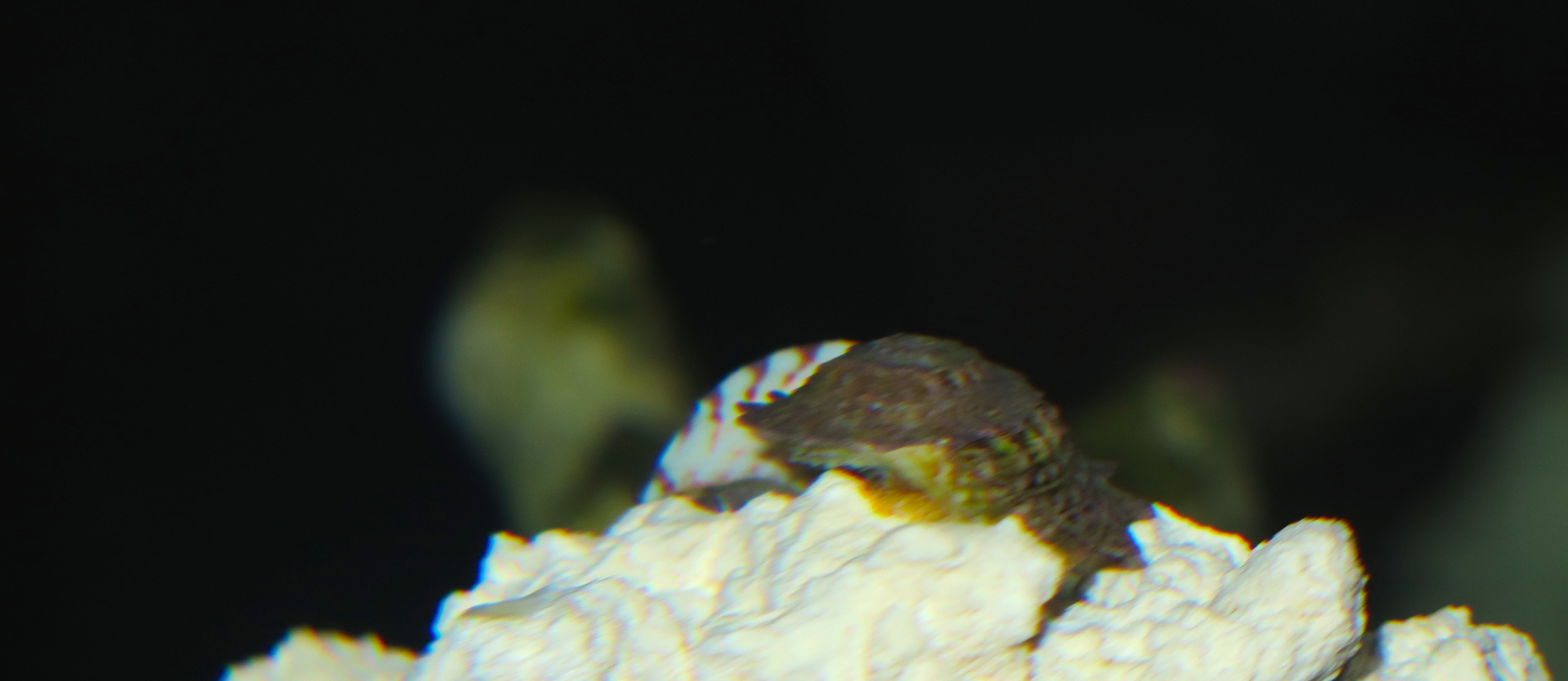
By today I should have my Thanksgiving menu completely planned, and begun shopping. Not a clue what I’m making yet. I intended to look through my cookbooks and start a shopping list this morning, but when I woke up, I saw this.
Fuzzy, but it’s one snail cleaning the shell of another.
It’ll be a small table this year, I’ll figure it out. Tuesday, when I remember the holiday is two days away and I haven’t so much as bought cranberries.
Massage is over, back to work.
I’m working on it, this finding my peace. Feeling withered, sure–but there may be some blooms to come.
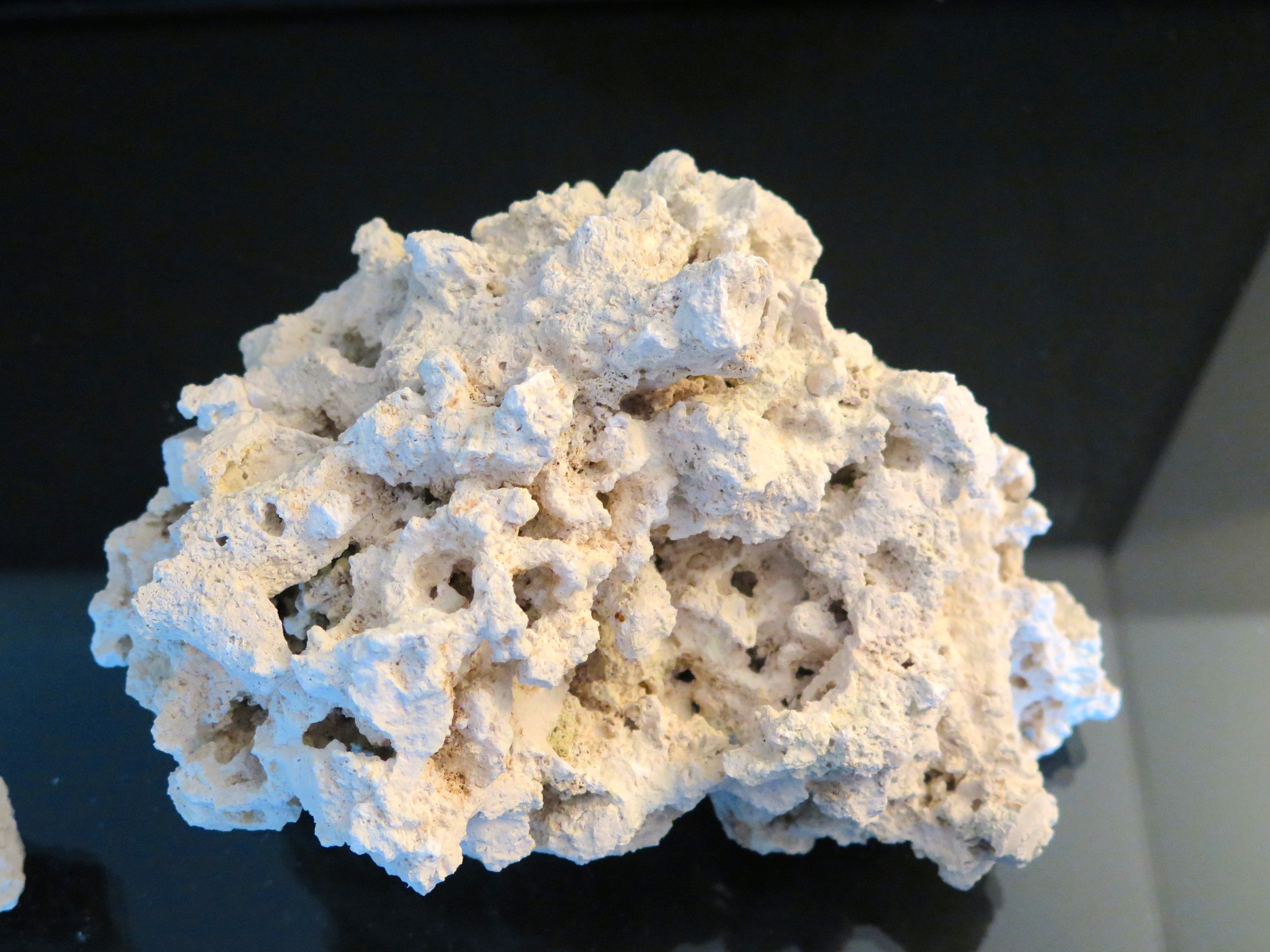
For those of you who aren’t reefers, the backbone of most reef tanks is live rock. Sounds crazy, I know. Live rock (and sand) serves as the biological filter in a tank, it’s what coral reefs are formed from–basically the skeletons of long dead corals. The rock itself isn’t live, but the beneficial bacteria and microscopic organisms that live in it are. It’s also very expensive. For this tank, I chose to go with reef rock that isn’t live, but “dry.” All those nooks and crannies in the rock are helpful, providing more surface area for the bacteria to colonize. It will take longer for the tank to cycle and be ready for livestock, but it’s a much more budget friendly option, and I will “seed” the dry rock with just a few pounds of live rock and many pounds of live sand.
I ordered 50 pounds of this rock, expected it to arrive today. Surprise! It came a day early. My intercom phone rang yesterday, the guard telling me I should come get my package. Of course this happened after my back was humming from doing a few loads of laundry, and right before I had to leave to pick the girl up from school. The gloom and rain of the day just added that extra something. I assumed it was a small package, yanno, the two ounce heater, maybe the hose for siphoning water. This guard is getting up there in years, and tends to get a little ummm, stressed, if you don’t come and take your packages right. now. I thought my back was humming after laundry? Bwahahaha! I couldn’t even look at the fucking box to open it until this morning. But now I have, and I had to immediately begin taking pictures because I’m a geek.
I spent last night and this morning thinking about the tank build and my writing. Both are intense, bring me peace and joy and angst and tears. Both endeavors I can and do lose hours in, often walking away feeling upside down and inside out. And I wondered, should I not have started this tank? I have people who seem to genuinely love my writing, several of whom have encouraged me to self publish. I could have put the money I’m putting into the tank into self pubbing Astonishing. Except it wouldn’t be enough. I write, and I self-edit what I write, but I’m no editor. I’m also not a graphic artist, able to design a book cover. Nor a computer savvy gal, able to convert the file into something readable on Kindle or Nook. Nor a marketing expert, able to get it out there. All things that need to happen if you’re going to self publish. If I’m ever published, trade or self, I want it done well.
It’s funny. Astonishing is magical realism, not a genre that’s popular or clearly defined in the adult market. Seems like many have their own definition and expectations for it. Maybe I should define it as written surrealism, instead of magical realism. Or hyperrealism, based on responses I get in regards to my characters, based on those ordinary people we walk past every day, who are extraordinary in the impact they have on each of us, shaping our lives. That’s what I love, whether I’m writing, reading, or reefing. Those small moments, how every creature–regardless of how many celled–affects every other around them, causing growth or a crash, it almost doesn’t matter.
If you’re a Fringeling, regular subscriber, or occasional reader, you know I have a completed novel looking for a home and champion, ASTONISHING. In the meantime, I’ve decided to post Chapter One here on the blog.
This is the story where I’ve allowed myself to go the furthest with the concept of what-if. It’s weird, the protagonist is an unreliable narrator, and if you’re looking for romance or happily-ever-after this ain’t your story.
It’s magical realism, my riff on what could happen if someone existed who was indeed a magnet for all the broken in our world–addicts, unmedicated and uncontrolled people with mental illness, those you don’t want to find across from you at the dinner table. So we’ve got these broken who’ve been flocking to Christina, but she can’t help them. Twenty-five years of this. By now she’s more fucked up than they are.
If Christina feels familiar (or for those newer to Mrs Fringe who are interested) “Miserosion”–the story on the page labeled Fiction– takes place 25 years before Astonishing, introducing Christina. Completely unnecessary to read to understand the novel, but it was a fun twist for me to write, and the original story idea that became the novel.
Because I’m more than a bit out of focus. I think about lines a lot. Don’t cross this line, don’t cross that line, balance on that one over there. Sometimes I feel like the lines shift, but do they really, or is it my perception–and oh! is that line on a fucking hill?
The line I’m thinking about this morning is, of course, writing and publishing. There’s a small group I’ve been spending some online time with. All talented and writing varied genres, all filled with optimism and hope. Different stages of pursuing publication, a couple who are self pubbing with thought and intention. Needless to say angst and self-doubts are part and parcel of writing, querying, and submitting, everyone takes turns pumping up whoever needs it most on any given day. Most of the members of this group are young, those who aren’t young are relatively new to the process. I don’t mean new as in still learning basic storytelling, but new as in less than 5 years of seriously pursuing publication.
I’m not young. Or new. At the moment I’m not writing or submitting. I still have several requested fulls out, but at this point any responses that come from them will be unexpected.
Am I the fly about to be captured, the trap that can only wait for food, or the blackened trap that needs to be removed before fungus sets in?
I don’t want any pep talks. I’m not angsting, thinking my words and stories truly suck. They don’t.
To me, worse than limping along to the battle cry of “I coulda been a contender” is the nonagenarian still waiting for their big break. Yes, I see/hear it. New York. Not that I’m ninety, or qualify for the senior discounted Metrocard, but still. I have to figure out if I’ve crossed the line from being patient and persistent to delusional.
There’s a part of my brain that will always be taking notes for future characters, will see that one moment, hear that one phrase that begins a story in my head. I will probably always write. I love blogging, I’ve enjoyed the experience of posting a couple of stories here on the blog, and suspect I will continue doing so every so often. But full length novels? Querying? Submitting? There’s a phrase I’ve heard a lot over the past ten years or so, maybe it was always there and didn’t come across my radar before, I don’t know–return on investment. Writing full length manuscripts, querying, submitting to the paying lit mags, these are things that require a lot of time, energy, work, and focus. I can’t help but wonder at this point if it’s a poor use of limited resources.
English: Drawing of Marie de Lorraine as the Duchess of Valentinois. She wears a ball gown (Photo credit: Wikipedia)
I’ve heard people talk about sharing their writing, how it feels/can feel like being naked. Not me. I don’t feel exposed when I share my work. Not to say I’m always completely confident, it’s like getting dressed and made up for an evening out–I think I look good, but I’m still hoping for some validation from whoever I go out with/run into. Cause there’s nothing worse than thinking you’ve got your game face on, and you run into someone in the lobby who asks if you’ve been ill. Because yes, that’s when I’m most likely to make the effort, when I feel the worst, physically or emotionally. That or I haven’t done laundry.
But submitting, querying…that’s a different story. At first I thought this end was more like working the pole, but no. Stripping may not be the most desirable way for every woman to earn a living, but it does earn dollars. This? Not a dime. I know, I know, I should have done this when my boobs were still in the same zip code as the rest of me. Living the dream, oh yes. The dream where you realize you’re standing in Times Square with no clothes on, not even a guitar to cover the saggy bits, a la The Naked Singing Cowboy.
Yah, yah, I’m not supposed to write these types of posts. Because for as much as you educate yourself about the business of publishing, follow agent and editor blogs and tweets about how things work, what their days are like, how many rejections they send daily (or don’t send, in these days of no response means no), the unpubbed and unagented are supposed to pretend we’re pure and innocent and virginal–just lucky enough or brilliant enough to know how to follow the rules or break the rules in a way that works, and haven’t received any rejections from anyone else. No matter how many times you read or hear publishing industry professionals talk about the many, many reasons they reject a work that often have nothing to do with with the quality of the writing, nope, those are the other wannabes. Not you, of course. Because, just like a wanton woman of yesteryear, no one’s going to want you/your work if someone else has already sampled the goods and didn’t like it enough to make a legally binding offer.
I’m a 40,000 year old woman with three children who are closer to grown than not. I think my days of playing the virgin are over. And Fringeland is about being honest, a blog to explore what it means to be downwardly mobile without being crushed by those climbing up.
Those stories you hear about people who receive an offer of rep and/or publication their first try? Their first dozen tries? Bullshit. Not saying they aren’t real, they are, but they are the exceptions, not the rule. I’d like to have been one of those stories, I’d like to be the mega lotto jackpot winner, but I’m not. The rules, the rules, all the rules passed on from wannabe to wannabe. The rules about how to interpret rejections, the nice and orderly progression from brusque form letters to nice form letters to personalized letters to invitations to submit more work to acceptance. Oh, the squeals of anticipation upon requests for fulls, personalized rejections, “you’re almost there!” Or not. I’ve been almost there since I started. Contracts in mirror are a fucking mirage, forget closer than they appear. The rules about the right way to query. Bullshit. There are wrong ways to go about querying, but no one right way. And hell, even amongst the wrong ways, there are stories of those who queried completely “wrong,” and still got an offer. C’mon now, there isn’t an agent or wannabe out there who hasn’t heard the story of the twelve year old kid who called the agent to query his book and got an offer. Not right then and there, and I don’t recommend calling agents’ offices when every US agent says not to do so, but obviously a phone call isn’t always the immediate and permanent never-to-be-published-blacklisted-forever-and-the-dystopia-beyond it’s portrayed to be. Does this mean I’m not smarter than a sixth grader?
I read broadly, across many genres. Yes, I have a special love for literary fiction, but I also love thrillers–political and psychological, some horror, contemporary, narrative non-fiction, and poetry. I read classics, and I read what’s being published today. Some books are so fabulous I want to swallow them so they’re permanently part of me, some are entertaining reads to pass an afternoon, and some, well, some I wonder what it is I’m missing that they were represented by an agent, championed by an editor, and published, a trade paperback I picked up for $14.00 off the shelf of the bookstore and wish I had instead tucked those dollars into someone’s g-string at the local Girlz Girlz Girlz. All my reading tells me something. I can write. Sharing manuscripts with writing friends (published and un, agented and un) and reading their feedback confirms I can write–if you don’t write, you’ll have to trust me here, no one is more adept at ripping apart a manuscript than others who write–feedback I’ve received from industry professionals tells me I don’t, after all, look sick when I think I look good.
Mrs Fringe hasn’t been innocent in a long time, if ever. But I’m still naked, and even though it’s July, it’s fucking cold outside.
A couple of weeks ago I was having a conversation with a writing friend about the query process. Surprising, it isn’t like I’m obsessed or anything. Sigh. And by conversation, I mean I said something like, “It’s never going to happen, I have a better chance of winning the lottery, blahblahsuckageblah. And my friend said something lovely and supportive like, “Oh, Mrs Fringe. Don’t say that. It can happen for you, it will happen for both of us, you have to have faith.”
I don’t play the lottery on a regular basis, maybe I’ve purchased five tickets over the course of my life. I wasn’t disappointed when I checked the numbers for the same reason I don’t play regularly–I don’t expect to win. I’m no math whiz, but I can look at the odds and know this is not a sensible way to spend a dollar.
I was saying there’s a specific aspect to querying that’s completely illogical, no different than playing the lottery, and yet here I am–hoping to “win,” even sometimes believing I have a shot. My guess (I’m not looking up the numbers and doing math) is that my odds are even worse than if I bought a lottery ticket for every query I send. If you pick the “right” numbers, you win your money, less the government’s share. Fair enough. But if a wannabe claws their way through the slush pile with sharp words and a clear, enticing plot to receive an offer of representation from a reputable agent, that’s just the first step. Because the jackpot (for a wannabe who wants to be traditionally published) isn’t receiving an offer of rep, it’s seeing your book in print, in a bookstore. So step two is the agent querying editors, in hopes of a publishing offer. Only a percentage of agented debut writers/manuscripts actually see a publishing contract. Step three is (hopefully) revisions with an editor and an advance, and then if nothing goes awry–step four, publication. That’s the winning ticket. Golden ticket is if the book actually takes off and you see good sales numbers.
There’s a disconnect, and even a wacky old gal like myself can see it. Too practical to buy lottery tickets, but oh yeah, I’ll query. And I’m lucky. Lucky to be receiving requests from agents to see the full. I wonder if full requests are like winning $2 on a scratch-off ticket, just enough to entice me to keep trying. Each request is a step, but quite far from an offer of rep–not to mention the neuron marbles lost with every ping of my email as I check to see if it’s an agent response. Patience, Mrs Fringe. Patience and faith.
Because I don’t play, I don’t know–do people have systems for playing the lottery, formulas and equations, the way people sit with the racing form at the track? I admit, I used to enjoy going to the track, where I had an elegant formula for which horse to bet on, using the names I liked the best.
My query formula
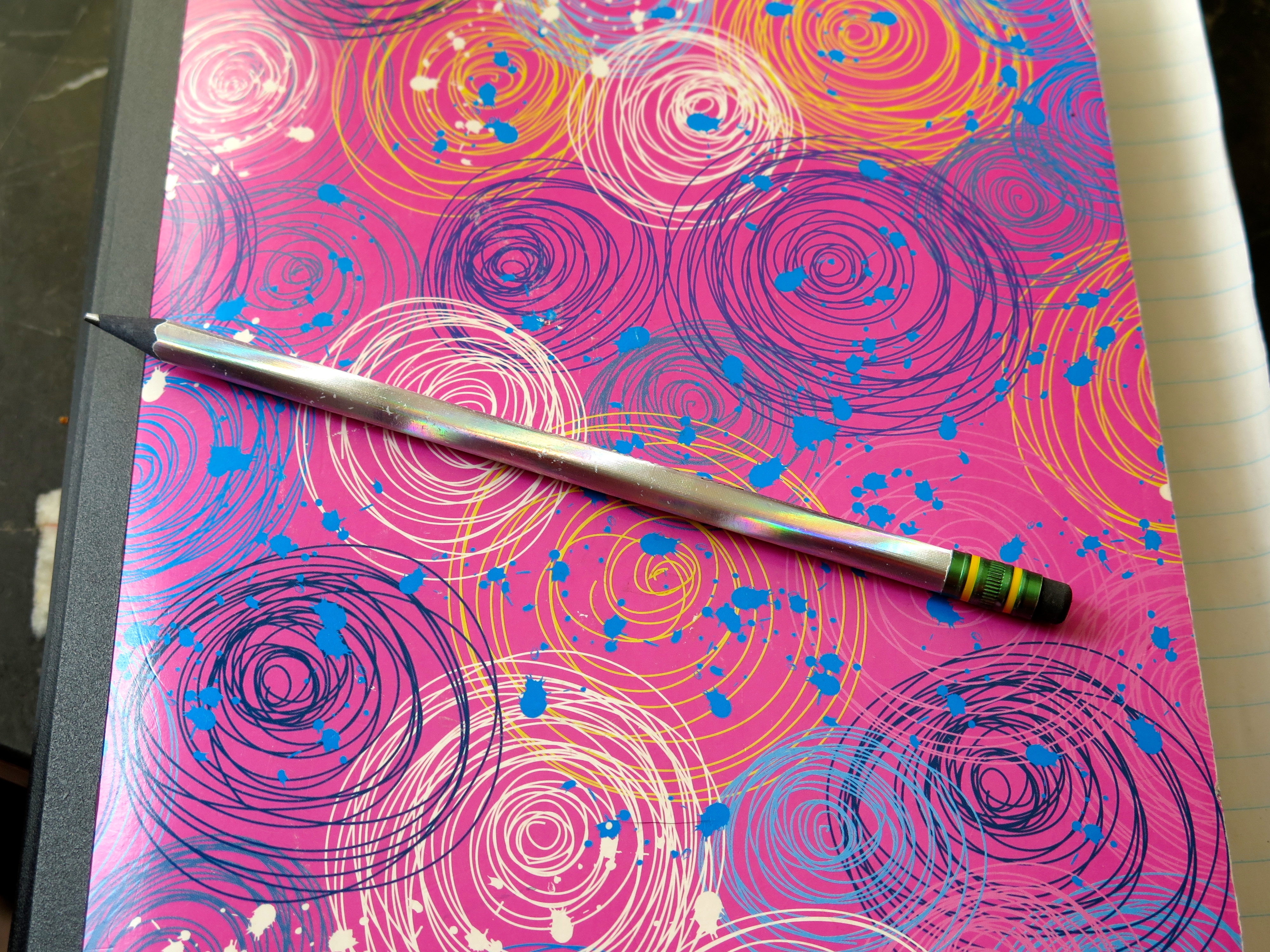
Above is my system. Sure I use the laptop to write and edit, but it’s a basic composition book for notes on the manuscript, and keeping track of queries. With, of course, my lucky pencil. Yes, it’s true, it’s that one specific type of pencil, exclusive to a Staples near you (maybe, they could be in other office supply stores also).
I had pushed this line of thinking out of my mind, but this morning on Twitter, I saw a tweet from an agent I follow. I think he’s an agent, he tweets anonymously as Agent Vader. For all I know he’s another wannabe, or a she, or the real Darth Vader, or the most powerful literary agent in existence. I don’t care, as long as he doesn’t send me to Jabba the Hutt in metal underwear. He’s often funny, and offers many great one liners about this whole business. Today he tweeted, “Writing is art. Art is subject to perception. This is a lottery. Most people don’t win the lottery.”
Yes. Yes, yes, yes. But I’ve got this little pile of winning scratch-off tickets that say please send me the full. And I’ve got beta readers and family and friends and Fringelings who say keep going. I’m even fortunate enough to have a couple of experienced, knowledgable-about-writing-and-the-publishing-industry friends who have read my work and tell me to keep going. But I’ll be honest, seeing and hearing the realities of this business, the long, long odds that involve the magical combination of writing that’s good enough, story that’s good enough, landing on the right desk at the right time, making the right numbers on a projected Profit and Loss statement in a publishing house, these are equally important. I’m wacky enough to believe I have a real shot, but need to keep my eyes on the sanity of facts and odds at the same time.
(I’ve posted this song/video before, but can’t think of anything more appropriate)
again. Even though I know it wasn’t meant for me, personally. Let’s face it, I’m a complete unknown–which is kind of my point.
Plate coral eating a silverside. So how come I feel more like that fish than the coral?
Earlier this morning I was going about my usual morning procrastinations, checking out Facebook, Twitter, etc, and I came across a link to this piece in the NY Times Book Review/bookends. I know this is a rant I’ve indulged in many times, but aaaargh! First let me say I haven’t read the original Lionel Shriver essay referenced, where she apparently wrote about feeling nostalgic for her previous commercial failure. Mmm hmm. I adore her work and believe she is truly a brilliant writer. Frankly, I’m pretty sure if I read her essay I’m never going to be able to read her fiction with an open mind again. At the moment I’m wishing I didn’t click the link and read what I did.
Francine Prose and Mohsin Hamid each respond to this question of author success, the pros and cons. Of course there are benefits and disadvantages, as there are to every choice, every person’s life/lifestyle/career. Both Ms. Prose and Mr. Hamid are successful authors, and it was Mr. Hamid’s (who for the record, has achieved both commercial and critical success) closing statement that has me pacing and ranting at my dogs.
“It’s a radical thought, but I wonder whether in some way we professional fiction writers might be better off if, like poets of old, we were to make nothing from our writing and had to earn our living elsewhere. Radical or not, it’s how most writers actually live today, working their day jobs, and writing — unpaid, alone, with passion — at night.”
Maybe my reaction is because I’m not part of that lovely “we.” I’ve yet to be paid for any of my words, therefore I am not a professional fiction writer. But I make no secret of the fact that I want to be, and won’t accept being shamed for it. If you want me to, I’ll admit to being a calculating bitch who wants my words to be read and I want to earn a dollar for them.
How unfortunate that my calculations are off. If they weren’t, I’d be part of the we, one of the published, one of the eek! successful.
math disaster (Photo credit: the mad LOLscientist)
What was I doing before screwing around online and reading this link? Obsessing, again, about when I might hear back from agents, and debating with myself about whether or not I’m doing the right thing by holding off on sending more queries until I do. Because I would like to receive an offer of representation, and I would like to be published. I’ll even go so far as to say I dream of being well published, and having my novel be well received. That dirty whisper of success.
I am not the voice of the unpublished everywhere. There are people who say they write solely for themselves, the work is enough, and if they’re never published they’re ok with that. Though I can’t relate to those thoughts, I accept them at face value. But they aren’t my thoughts. As I’ve said many, many times before, I write to be read. When I write, yes, I write the story as I see it, the characters as I imagine them, but I write with readers in mind, thinking about which words might be most appealing, which images will make sense to readers other than myself.
I do appreciate Mr. Hamid’s statements about commercial success involving luck. I read no hint of dismissal or condescension in this, the talent and skill have to be present for any writer to be in a position to receive such luck, but yes, it’s a part of “big” success.
No doubt, there is a certain luxury in the process of writing without contracts or deadlines or expectations. If other areas of my life are extra busy–hell, if I don’t feel like it! I don’t actually have to produce any words. And I’ll go further, at this moment, I don’t have to think about bad reviews on Goodreads, or worry about what my children’s teachers–or my children–will think of me, personally, when/if they read my work. That isn’t nothing, negative reviews and sometimes personal attacks are hurtful, even if you’re cashing a check. From my limited view of the world and the publishing industry, would I trade these luxuries for a few readers and a contract? Absolutely. Am I crass for admitting this? Maybe I’m just not that deep.
When Man Child talks about becoming a chef, and I see him busting his butt putting hours of hard, sweaty labor into it–not just cooking, but learning about other cultures, becoming fluent in other languages, and learning the business skills necessary, I don’t pat him on the head and tell him how wonderful it is that he can cook his own dinner. And no one else responds to him by saying hey, maybe one day you can be a fry cook at McDonald’s.
The reality is that very, very few of those who attain publication will achieve such success that any of this is even a question. As quoted above, not many published authors get to “quit the day job.” No one argues this, not me, not Mr. Hamid, not anyone with any remote connection to the publishing industry. I know this is the reality, but when I dream, that’s what I dream of, not nobly burning my pages for warmth and starving in a garret.
I kept playing with that story. It started with the idea of a twisted nod to the pressures of “romance” and idealizing others. Sounds so modern, so 2014, right? Shakespeare wrote Romeo and Juliet over 400 years ago. You know the one where a 13 year old girl and a 17 year old boy decide they’re in love, and within days both of them and several others are dead. Who wants a glass of champagne?
While I was thinking about it and before I began writing it kept changing, of course. Filling in some parts and omitting others. I had the idea to put it in second person POV. For readers who aren’t writers and well past grammar classes, second person is when the protagonist is referred to as “you,” as opposed to “I” (first person) or he/she (third person). Not a popular narrative choice, it can be disastrous, calling attention to the fact that you’re reading a story (as opposed to getting lost in it) or, on rare occasion, it can work very well.
I’m still undecided as to how well it worked, but it was an interesting exercise for me. I’ve never tried it before, and it brought me very, very close inside the main character’s head, and left me feeling a little breathless, even while I felt the breath of the protagonist. Strange. And nice to stretch a bit while I created some new characters.
It’s got a touch of magical realism, which I might or might not leave in if I ever change or expand it, one of the bits inspired by a photo I took on the street recently of a dead rat next to a cigarette butt. I was going to put it here, but Husband tells me that would tip the scales from edgy to tasteless and gross. My gut tells me at least half of my readers would agree with him, so I’m leaving it out–I’ll let Husband know you all said thank you.
Macbeth and Banquo with the Witches by Henry Fuseli (Photo credit: Wikipedia)
It was a long week here in Fringeland.
I’m still waiting to hear back about the fulls that are out for Astonishing, and still waiting to hear about the apartment. I could send more queries, but I don’t want to. Not yet. Frankly, I can only hold so many details about who has what in my wee brain before I’m overwhelmed, and this feels like my limit. Sure, I have it all written down, keep notes and dates, but still. Nothing like endless waiting to make you feel insignificant. Passive. For someone who writes, passive is a cardinal sin. Good stories, good characters, have readers turning pages because they want to know what happens next. Nothing happening, pouring the ninth cup of coffee? Yawn. If I were a character, I’d write myself out of the manuscript, or make horrible things happen to force myself to act.
Clearly, the answer was to start writing that story I’ve been thinking about. Never mind that I wasn’t ready to start writing. For a lot of people who write, that is the answer. So I opened up a fresh blank Word document, and started writing. I didn’t write the whole story, but a lot of it. And it sucks. Because while this method works for many, it doesn’t work for me. Not for short stories, anyway. I have to be ready, the characters need to be complete and clear in my mind, even if I don’t actually know exactly what they’re going to do until they’re doing it.
I have some very kind and generous followers here in Fringeland. Kind and generous enough that I would bet $5 that two of you read that last paragraph and thought to yourselves (whether or not you’ve read any of my fiction), “it doesn’t suck, Mrs Fringe is being too hard on herself.” Nope, I’m not. Sometimes I write things that I think are pretty good, and sometimes I write things that I know should be burned, never to be seen by readers. It’s part of writing, and in my opinion, it’s an important skill to have.
But between the unending waiting, the passivity and the suckage of that short story, I had a couple of those days. Odds are if you write, you have them yourself. The ones where you’re convinced that you have nothing to say, no grace when saying it, and every file in your thumb drive is evidence of your inability to phrase a coherent sentence, let alone craft a story someone would want to read. This then leads to, “that’s why I haven’t heard back from the agents. It isn’t because it’s conference season, or because there’s been 15 strains of crud viruses tearing through the city and I’ve seen many of those agents Tweet about being sick, and it certainly isn’t because they’re busy working for clients–you know, the ones that allow them to pay their rent, eat, and read queries and requested material. No, no. It’s because of the unbelievable level of suck in my manuscript.”
And then I had a day where I was laid out with the mother of all migraines. I’ve gotten them for years and years, very familiar, and this might have been the worst one I’ve ever had. My skull felt like a damn eggshell for about 24 hours after it ended.
Last night Fatigue came for dinner. Turns out I wasn’t yet ready to enjoy a beer, but still, it was a nice evening, and after Art Child went to bed I read him the next two chapters of Astonishing–our current Friday Night Madness routine. We’re past the halfway point in the manuscript, the tension is tightening, and Christina (main character), well, Christina is starting to really feel the effects of her drinking as she makes poorer choices, and the lines between real, surreal, and plain old alcohol warped perception become more blurred. Fun, the last scene I read to Fatigue ends with a quote from Everything’s Coming Up Roses from Gypsy. Fatigue is a cabaret singer with an amazing baritone, and after I finished–you know I didn’t sing the lines with my Edith Bunker voice–Fatigue sang them.
And I had this moment. Because Astonishing doesn’t suck. It was a good scene, a good couple of chapters, and there is enough there for me to still believe this manuscript will be the one. It was the right time for me to write Astonishing, and I think it is the right time for Christina’s story to be read.










 mrsfringe